What is genealogy research?

What is Genealogy Research?

If you’re reading this there’s a good chance you’ve at least looked at online tools and services that can help you learn about your family history and lineage. I use and like these genealogy research tools, but there’s nothing like the excitement I felt when I received a packet in the mail from the county courthouse in Omaha, and finally learned the names of two of my great-great-grandparents. I was no longer stuck. Nothing in my life until then brought so much excitement as finding two names written on a piece of paper.

The information about my ancestors ended up taking my husband and me almost 5,000 miles round trip between Minnesota and Nova Scotia. In Nova Scotia I learned about my 4 times great-grandfather, Moses Stevens. Moses was born in Scotland in about 1785 and settled in Nova Scotia as a child. As an adult he requested and was granted 200 acres from the British Crown. After finding the land record, my husband and I found the property and drove down an old logging road and got lost in the woods. 

Why was this so important to me? As I said in my earlier post about Ralph Reed Stevens, I didn’t know anything about this family until I started doing research, and then I found myself wandering around the wilderness on a piece of land that my ancestor owned. I felt roots. It gave me a great sense of belonging and of being not so alone in the world.

Learning about my own family history has given me the passion that I bring to my new career, but my background in finance and technology reminds me to apply Webster’s definition of genealogy: “the study of family ancestries and histories,” and research: “Diligent and systematic inquiry or investigation into a subject in order to discover or revise facts, theories, applications, etc.”

When I research your family ancestry and history, I do it for the “a-ha!” moment; your’s and mine. My training and experience in finance and technology helps me bring diligence and systematic inquiry in order to successfully bring about our “a-ha!” moment.

I have done heir and probate searches that have helped to settle estates, uncovered bizarre stories in old newspapers, scanned railroad records that helped a person conducting due diligence, and even found connections for a mystery cousin who showed up on a DNA list.

Many of you have seen the ads for Ancestry.com and how just clicking on a leaf can bring your ancestors to life and give you a world of knowledge about your heritage that will change your life. But there is much more to genealogy research than that, and clicking on the wrong leaf can take you in the wrong direction and give you false results.

Genealogy research can be as simple as making a copy of a death record or scanning some crumbling papers in an old file, or it can be as complicated as determining someone’s biological grandparents. SliverLinings Research can help you get answers to your questions, and help you to come up with new questions about your family history and your ancestors and your lineage. We would enjoy the opportunity to help you tackle your family mysteries.

Sara Bratsch
RALPH REED STEVENS

Ralph Reed Stevens

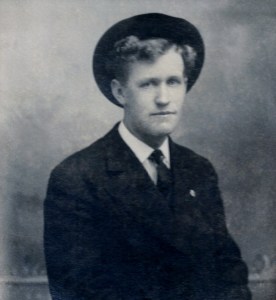
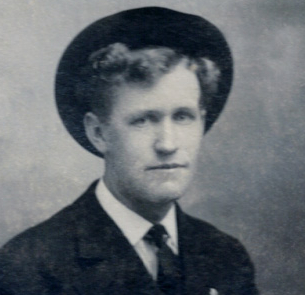
This is a photo of my great-grandfather, Ralph Reed Stevens. I never met him since he died many years before I was born. He would never know or understand that he was the inspiration behind my obsession with genealogy.

It all started when I was in my early 20’s. My dad had taken a trip to overseas to Romania to see if he could find some of our long-lost relatives on his mother’s side. He wrote about his trip and I will publish that story in a later blog. When he returned home, he was very excited and told me about the people he met and the adventures he had. He suggested that maybe I could start looking at his father’s side to find out whatever happened to Ralph. He also gave me two sheets of stenographer paper that had the small, crimped writing of my great-grandmother, Myrtle Elzina Stevens (nee DeHaven), who was Ralph’s wife.

You see Myrtle was very close-lipped and bitter throughout her life. She raised my grandfather, Lester Ralph Stevens, as a single mother and never re-married or had any other children, and she never told Lester what happened between her and Ralph. On the steno-paper was one sentence that popped out at me: “Left Ralph in Oakland, Calif in 1913 when mother died.” This one sentence led me on a trip that would start me on my genealogy journey. I became obsessed with finding out what happened to Ralph and went further down the road to finding my roots than I could ever imagine. Although I eventually did find out what happened to Ralph, I would never find out why Myrtle left him.

I started with this sentence one other small clue; I also knew that Lester was born in Denver, Colorado in 1909. That was about it. I began reading through old post cards and reading books about family history, visiting libraries and historical societies, and even going to Irish fairs and events. I considered this the “bumbling” faze of my research, since I had no idea where to go or what to do. I even stopped briefly at the Denver Public Library on a trip through in 1997 and found absolutely nothing. I eventually found a framed marriage certificate that my dad had that indicated Ralph and Myrtle were married in 1908 in Omaha, Nebraska.

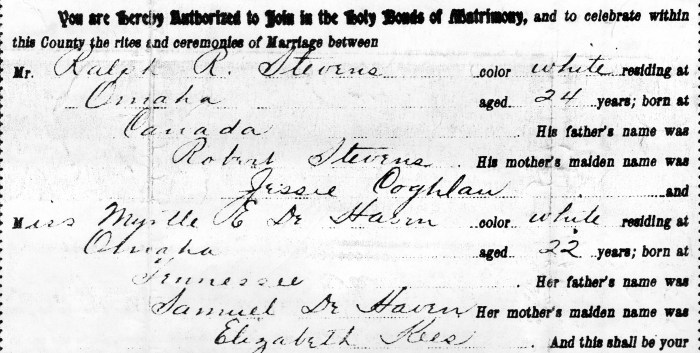
From the marriage place and date I was able to send $5 and a SASE (self-addressed, stamped envelope for us old-folks!) to the Douglas County Historical Society in Omaha, for a copy of Ralph and Myrtle’s marriage license. After several months of waiting on pins & needles, finally a large packet arrived in the mail. It contained a copy of the marriage license, which listed both of their parents’ names. Although I already knew Myrtle’s parents names, I can’t describe the excitement I felt at learning Ralph’s parents names. Nothing in my life so far brought so much excitement as finding two names written on a piece of paper. At the same time, with it brought more questions: where, who, how, why?

So began my long journey of discovery. I found that Ralph had been born in Owen Sound, Ontario, Canada in 1883. He and his parents immigrated to the United States in 1884 when Ralph was just a baby. The family homesteaded property in Minnesela, South Dakota and Ralph’s father, Robert Scott, was the one of the first sheriffs of Butte County, South Dakota. Robert and his brothers ran a stagecoach between Minnesela and Deadwood, where Robert also worked in the mines and eventually died in 1904 of lung disease. Ralph had five sisters, all born in South Dakota with one who died young of “Quincy.” Ralph’s mother, Jessie Patton Coghlan, left the family in 1899 to start a whole new family with another man and had three more children. This is probably what brought Ralph to Omaha where he met Myrtle.

Right after Ralph and Myrtle married in 1908, they traveled to Denver, Colorado, where my grandfather, Lester Ralph, was born, and then shortly after on to Oakland, California where Ralph worked as a boilermaker and ship builder for the Southern Pacific Railroad and other shipping companies. Although Ralph and Myrtle never divorced, Ralph re-married but also had no more children. He died in 1925 of a brain aneurism in Compton, California. He was a member of the Maccabee’s, and went on a trip to Portland, Oregon in a Chevrolet ‘490’ in 1918.

I researched the family back two more generations to Nova Scotia, Canada and then to Scotland. I have made research trips to South Dakota, Colorado, California, and Ontario and Nova Scotia, Canada. I have spent many, many hours researching census records, newspaper articles, city directories, marriage and death records and even employment records. I have found all of this information and more about my great-grandfather where previously there was only one sentence on a piece of steno-paper. Although probably not a particularly eventful life, my great-grandfather now has a story and a rich history that I can pass down to my children and grandchildren.

You see to me, genealogy isn’t just a series of dates and places and who married whom, it is a history of my family that didn’t exist before I found it. My ancestors come alive on the pages that I research, and they all have stories to tell. I hope that one day you will have stories to tell your family too.

Sara Bratsch